
Stirring up Emotions
Lentils, loss, and loving yourself even when you get it wrong.

On this day, I woke up with some sort of synthetic consciousness to take care of myself in a maternal way, something I would not rank myself highly on.
Some people fake it until they make it in the boardroom, mine is nurturing myself in a healthy capacity.
At this point in time, I’m trying everything I can possibly do to ‘life-max’. I’m being social. I’m working my ass off. I’m completing all these side quests. I even had a therapist tell me I might need to find a new hobby to take my mind off the idea of achieving something, but as she said it, even she knew it wasn’t going to work. I thought about the moments in life where I felt most present, but I kept hitting a roadblock, everything I thought of felt too rushed, too expensive, or physically out of reach (I can’t live at a music festival 24/7).
One of my closest friends, Jess bought me a Greek cookbook. I hunted down a low-effort recipe for a Saturday lunch and decided on lentils, something time-consuming enough that it would be tender and comforting, but also time-saving enough that I could do my chores in between. Maybe not the most present move I could be making, but I finally had a day to myself that didn’t involve a high-energy event or work on my Saturday. I also haven’t been sleeping the last couple of nights, and I’m due for an emotional crash. It’s like clockwork at this point.
I spent the time chopping.
The chopping of the carrots and the peeling of the potatoes were the equivalent of the gritting of my teeth. No part of it felt pleasurable, more like a chore, in the sense that I could be doing literally anything else right now when, in fact, all I would otherwise be doing is doomscrolling on my phone. And instead of feeding the idea of myself, I would be feeding my insecurities about where I ‘should’ be in life, basically defeating the purpose of the act of slowing down.
What should I be doing with my body? Where should I be putting my energy? Why am I not successful yet?
And the spiral of ‘it’s never going to be enough, so why bother at all?’.
Whilst placing the onions in to saute, stirring them slowly and cautiously as their fiery attacks of oil could ambush me at any moment, the act of cooking itself feels performative. I understand cooking is meant to be pleasurable, however, in this moment, it’s boring and mundane, borderline ‘trying too hard’.
I feel the aesthetic participating in it, like a witch completing a ritual with the fresh herbs and ingredients she picked herself.
In this case, Woolworths. (Which felt like a crime in itself, as I am a Coles girl through and through).
Every Saturday when I was a kid, I used to complain about wasting precious Saturday hours on grocery shopping. I could have been playing SingStar. I could have been reading my books. I could have been playing on my Nintendo DS with my Nintendog Daisy, who was due to be the number one champion in the agility competition (when in fact I owned a border collie in the real world). I could have just been outside in general; a lawn of grass was a gift that could be any kingdom I wanted it to be. Yet my mum insisted we head to the shops with my Yiayia (my grandmother). It felt ridiculous that is what Sundays were for, didn’t she understand that? Even at the ripe age of eight, I knew Saturdays were for dancing, sleepovers and drinking.
One thing that would consistently bring me comfort was the food my Yiayia used to make. No matter what time of day, wherever we were, she was ready to go. It was always good to know that anywhere I was in the world, there would be a plate of something waiting for me made with patience and love.
Over the stove as I cautiously add the chunkier vegetables, I think of my Yiayia and how she would cook her own meals. Most of my childhood centres around the memory of her at the stove, inviting me over to taste, to smell, to watch, an activity that brings me so much boredom now, but created so many memories with someone who’d lived many lives and was grateful to be cooking in her own kitchen, safely, in her own home.
I think about the last time we truly spoke. The four walls of a care centre that felt like a bachelor pad from a ‘90s rom-com, a deep red wall with stark, contrasting furniture, a giant bed in the middle of the room, and a plasma TV blaring across from it. My Yiayia sat in a chair across the room watching the National Geographic channel, watching it the way you’d watch a lava lamp finally start to form its goo.
She was dressed in a navy blue robe, the only colour I’ve ever seen her wear outside of black. She responds to my entrance immediately, her face smiles, yet her words tell me off like I’m nine all over again. “Why are you here with me on a Friday night?”.
I laugh a laugh reserved only for her and pull up a chair. She pulls me in and touches my face to get a good look at me. She tells me my skin is looking good, but that I need to go outside more.
I tease and tell her the same thing.
We usually talk about food, because it’s the most Greek I know, and it makes the conversation easier for both of us. From the vegetables she grew to the dining room table, my language skills revolve around hosting and what’s on the plate. (Please don’t ask me to have a conversation with me in Greek about my day, but I can tell you that different varieties of pasta are much more important).
She doesn’t ask about boys as much as she used to, not because it annoyed me, but because she became more interested in me working. She’s so happy I’m working. She’s happy I have a life.
She doesn’t ask about my future, she asks about now. She wants photos for the bits she can’t explain. I feel guilty that I can’t speak to her the way my sisters can, but she doesn’t seem to mind. She tells me how I have a niece now, it’s something I learn with her, something she’ll remember if we do it together, and that’s what matters more. That’s what ninety years teaches you.
She looks at me in my baggy tracksuit and tells me to stop hiding myself. She jokes about how it swallows me, and that I need to flaunt it.
We sit and watch a program about sea cucumbers while flicking through a phone book from before I was born. My contact details aren’t in there, but Nikki from Doncaster East’s are. When I ask who Nikki from Doncaster East is, she just shrugs at me, the way a classmate would if they were your best friend but didn’t know the answer either. She pauses, and we both laugh at each other.
I remember thinking, “I feel happy that I am here with her. She expects nothing of me but me”.
Afterwards, I headed to the supermarket and noticed how quiet it was, there was nowhere I needed to be.
I do everything right. I pick the freshest ingredients. I stroll the aisles like she would, like time doesn’t exist, like the people around me are just moving statues in a gallery that is a haven of food. They don’t interact with me, and I don’t interact with them. I try to smile at the occasional person, the way she did, except she didn’t speak English towards the end of her life, so she never got stuck in conversation the way I do, which makes the process even longer. But I don’t regret talking to people.
Now I only do my grocery shopping on a Friday night or a Saturday, even if it’s after an event, because I’ve realised how important it is to keep Sunday free, not running around the shops, not rushing, really valuing my time so I can spend Sundays properly. Saturdays are quieter in the shops, and Sundays are quieter at home.
My grandmother passed away at the end of last year. It’s something we’d been coming to terms with for a very long time, but it still didn’t hurt any less when it happened. She lived every day in her home. She cooked for herself every meal, and she was thankful. In the second part of her life, once she’d been guaranteed freedom from immigrating to Australia, I have a memory that my grandmother didn’t fear talking about death. If anything, she waited patiently, like a flight that was booked well in advance for a holiday, so far off in advance, you didn’t quite believe it was real.
My mother spoke a lot about dying with dignity after my grandmother chose to go, and as true as that is, I do believe her when she says it. It wasn’t surprising, reflecting on her life, that she’d also found patience and dignity and peace within her time here on Earth.
Each family member has their own version of her to remember, and this is mine.
I talk to her more now than ever, asking where the salt is, what song I should play next. I go outside more and try to wear something that shows off a little more, whether it’s a gold hoop earring to work or something that has a little bit more shape in the body. I knit in front of my soaps and ask how I fix the wool, when in fact it’s too far gone to be saved. I try to be in the now like she was, remembering every single step of the ingredients, but also making them my own, what she’d learnt from more than just a cookbook, or a life instruction manual, by feel. She just trusted she knew. And you know what? She did.
I try not to go on my phone in between stirs, and instead stare at the pot, hoping some curse will lift with the smell of onion and garlic, hoping she’ll talk to me and tell me what to do next. Life hasn’t been cruel, but I feel like I’m not doing enough. This simple act of cooking is doing more than enough, because it takes me back to where I’m meant to be: in my own body, in my own home, putting myself first instead of scrolling on my phone or wasting time, giving power to the “higher at be”.
As it hits what feels like the third and final hour in the pot (it’s been forty minutes), the patience, the performative act of being in the moment, has moved on from being a costume. I’m genuinely looking forward to eating this meal. As I serve myself a plate and sit down on the couch, I feel her with me: watching, nagging, telling me to get into it, telling me to be thankful for the food, even though I’m not particularly religious.
As I take my first bite, expecting the warmth and gravitas my grandmother would have provided, I realise this is the saltiest food I have ever tasted in my entire life. It’s like I’ve swallowed the Dead Sea and then topped it with a salted rim from an overpriced margarita. I triple-checked the recipe. I’d done everything right, and yet it still blew up in my face.
Because that’s what it’s all about, right? It’s trying. It’s failing. It’s experimenting. It’s remembering that I made the worst lentils of all time, but that doesn’t deter me from making them the way I know they’re meant to taste.
But instead of crying, instead of cracking, I simply laugh.
It doesn’t mean I loved myself any less because I’ve failed, I’ve loved myself because I tried.
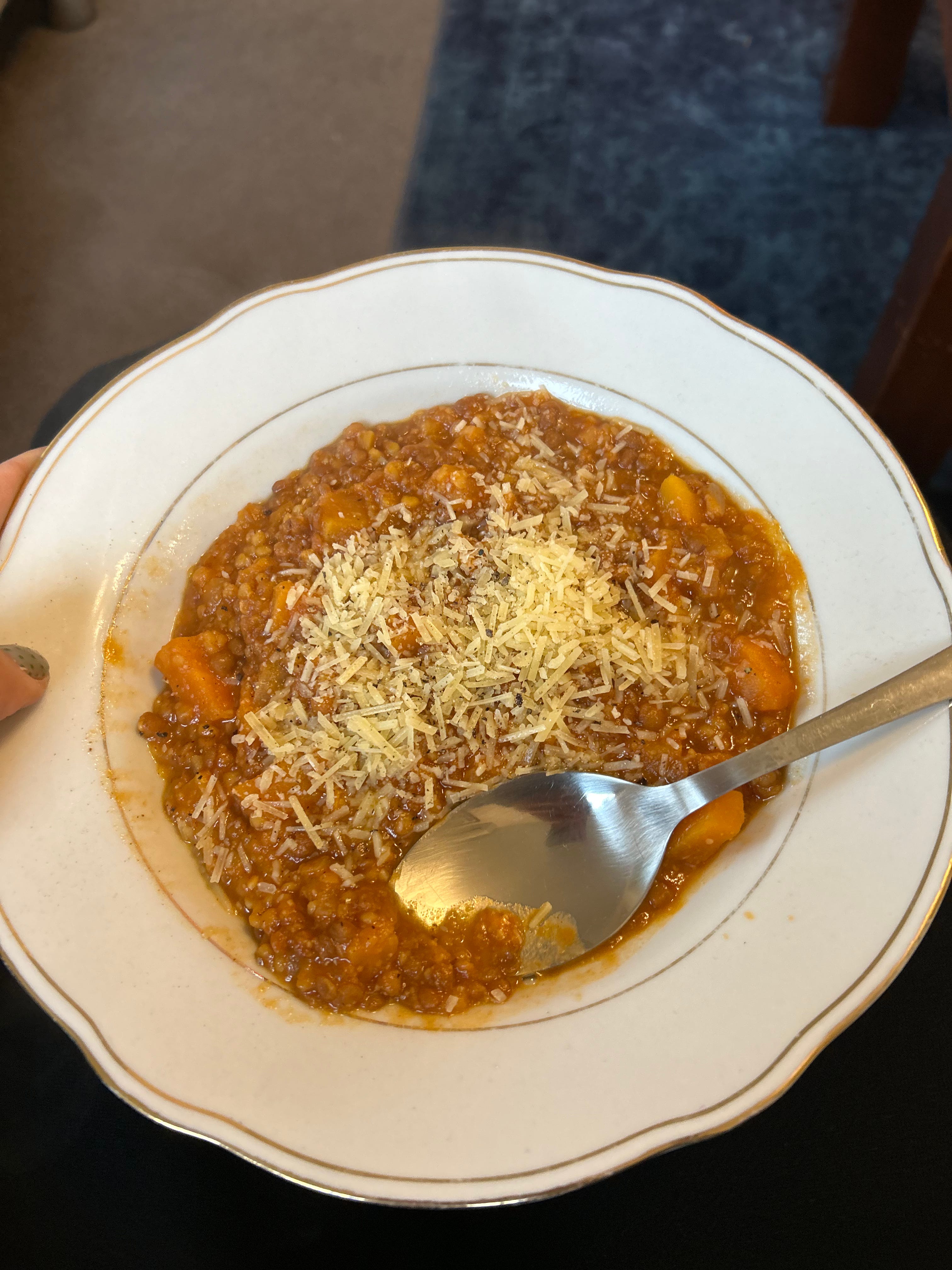
Loved this